Karen Butterfield, ’75, ’80, ’93 (Hon.), ’95, always knew she wanted to be a teacher.
“I remember my parents gave us a big chalkboard for Christmas one year. I would play teacher and make my sister be the student,” she says with a laugh.
“The word on the street was, if you want to be a teacher, you go to NAU,” says Butterfield. For more than a century, NAU’s College of Education has been recognized as one of the state’s most respected educator-preparation programs, known for its deep partnerships in rural, tribal, and high-need schools.
So, she went to NAU, and her experiences as a student became the foundation for her life’s work as an educator, mentor, leader, and advocate.
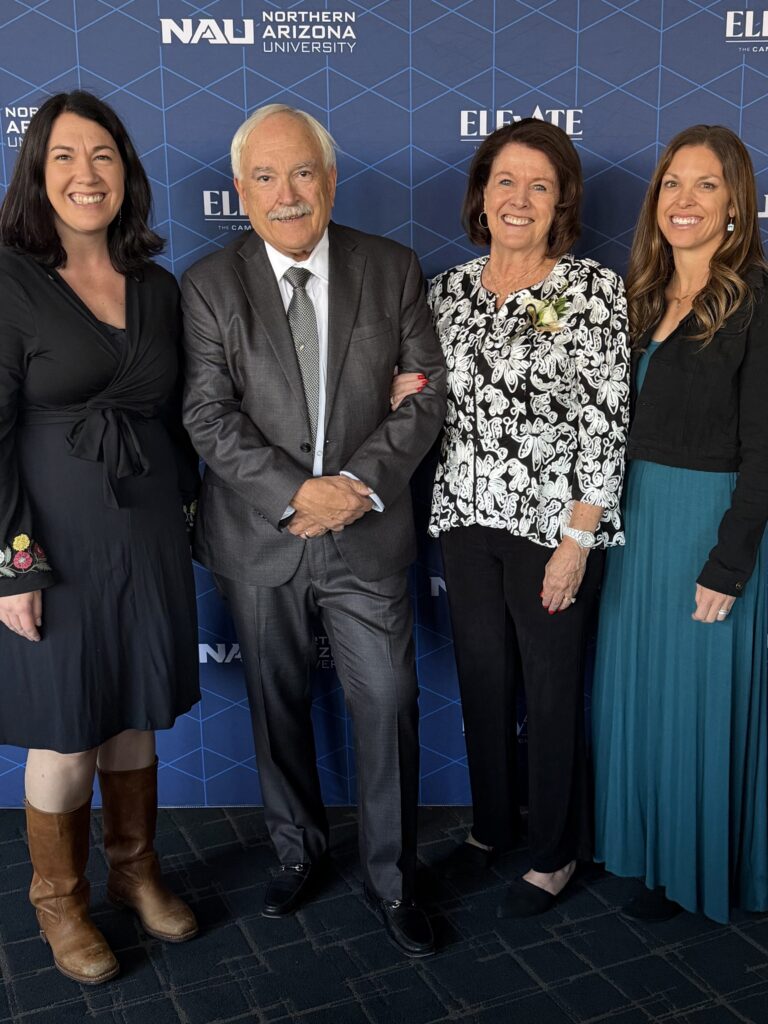
This year, Butterfield received NAU’s Dwight Patterson Alumna of the Year Award, presented annually to an individual who has achieved outstanding success in the private sector outside of government or nonprofit service. For an educator whose influence spans classroom teaching, school leadership, statewide policy, arts education, and national impact, the recognition reflects a lifetime of meaningful work.
From her early days teaching art in Flagstaff to her leadership roles in the Arizona Department of Education to her national work supporting Native-serving schools through her role at WestEd, with the Bureau of Indian Education, Butterfield’s career has been guided by a simple principle: listen carefully, learn continuously, and uplift others.
Although Butterfield taught in Flagstaff for many years—often working with Navajo and Hopi students—her understanding of educational equity transformed during an immersive professional development experience, sponsored by NAU and Flagstaff Unified School District, at Diné College.
“I can’t tell you what it did to me on the inside,” she says. “I went back to school the following Monday a totally different teacher.”
She apologized to students for assignments that clashed with their cultural norms. She invited them to tell her what she needed to know. They did—affirming her belief that understanding students deeply, culturally, and personally is essential, not optional.
Butterfield’s connection to NAU became a multi-generational one. Her husband Ernie, ’76, and both their daughters—Katie Krause, ’11, ’22, and Amanda DeRosa, ’04, ’07—later earned degrees at NAU.
At her 2022 induction into the College of Education Hall of Fame, Butterfield realized it was time for her family to give back: “After hearing how other honorees were impacted by their time at NAU, Ernie and I looked at each other, and he said, ‘It’s time we give back to NAU.’ And I said, ‘Yes. It is.’”
They created the Butterfield Family Educator Leadership Scholarship—a fund supporting students committed to teaching or leading in high-poverty, rural schools serving Native communities.
The scholarship’s inaugural recipient, Kayla Nelson, ’26, is an elementary education major from Jeddito, Arizona, on the Navajo Nation. She hopes to teach in her hometown and eventually take on a leadership role supporting culturally responsive education in Indigenous communities.
“As a member of this community, I also hope to serve as a role model, showing students that they can achieve their dreams and, in turn, give back to their own communities,” says Nelson.
“Receiving this scholarship is a meaningful investment in my future as an educator,” says Nelson. “The Butterfields’ support encourages me to keep moving forward and is a reminder to me that I am not on this journey alone.”
For Butterfield—who now offers steady, seasoned guidance to Nelson—this is exactly the point.
“I want Butterfield scholars to grab onto a mentor and hold tight. That mentor can help you get through roadblocks, and ultimately support you in making a difference in the lives of your future students,” she says.
It’s the perspective of someone who understands how transformative that guidance can be—and who is determined to ensure future educators have it, too.