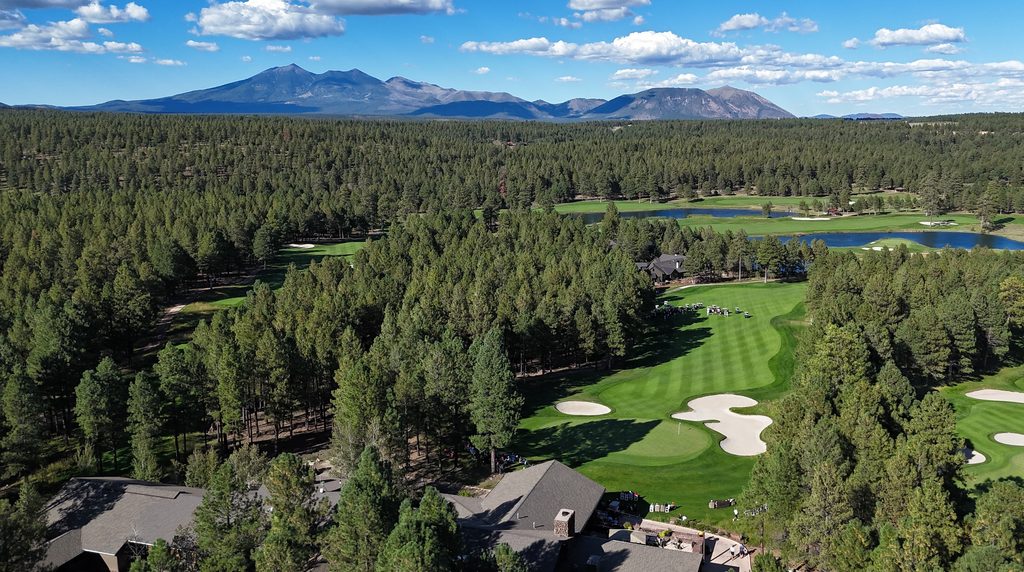
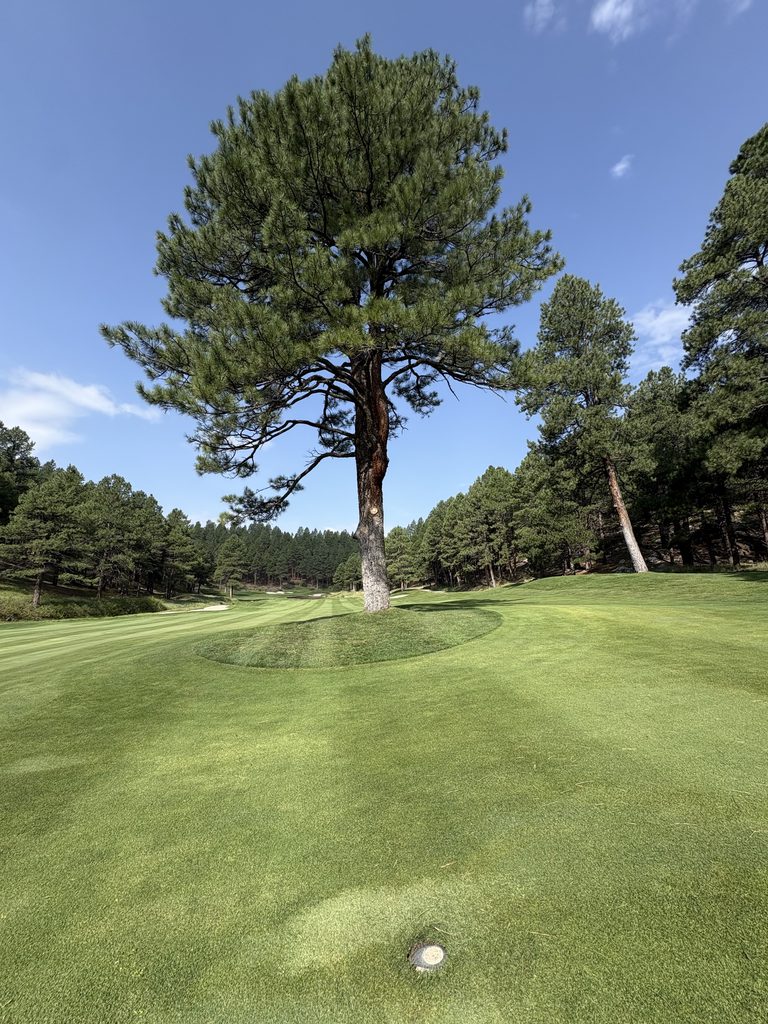
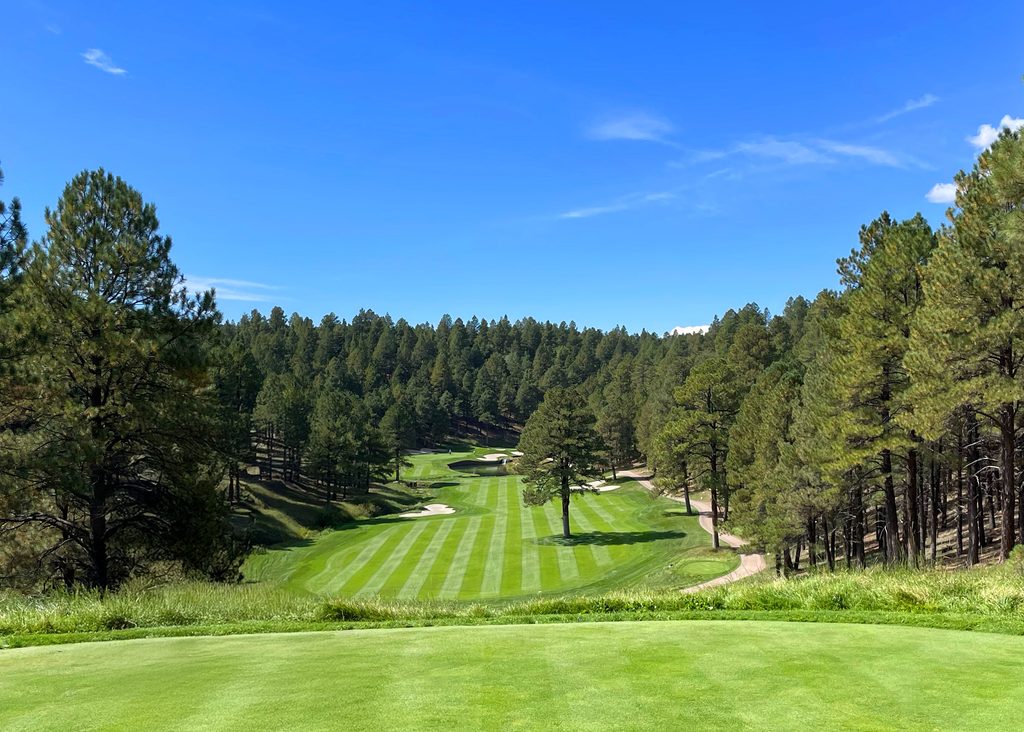
Some of the ponderosa pines standing in Forest Highlands Golf Club’s (FHGC) fairways were there long before the fairways themselves. The club’s two courses are 39 and 27 years old while some of their signature ponderosas are up to 140 years old. Golf holes were designed around them, and their size and placement influence how golfers play.
That makes losing one about more than losing a tree.
“The trees are integral to how the hole is designed, how it’s intended to be played, and its view,” says Andrew Hedrick, director of golf at FHGC.
Ponderosa pines are adapted to the relatively dry conditions of northern Arizona, but trees incorporated into golf course fairways are repeatedly hit by irrigation intended to keep the surrounding turf green. FHGC staff knew excessive water could be detrimental to the trees. What they needed was research quantifying what was happening—or what they could do differently.
At the same time, FHGC was thinking more broadly about the health of the nearly 1,200 acres it manages. Historically, much of its tree management had been reactive: A tree affected by drought, bark beetles, mistletoe, or other damage would eventually be removed. Club leaders wanted to become more proactive, drawing on forestry expertise to understand and improve the health of the landscape before trees reached that point.
Just minutes away, NAU’s School of Forestry had students and faculty looking for places to put their knowledge to work.
“We would learn from them, and they were going to learn from our landscape, so we could both benefit,” says Bill Abbey, ‘88, director of agronomy at FHGC.
Turning a shared need into a partnership
Those complementary needs led to a partnership between Forest Highlands and NAU’s School of Forestry. Forest Highlands committed $25,000 for the program’s first year: $15,000 supported a Dean’s Distinguished Fellowship, a 10-week summer research experience for an NAU forestry student on Forest Highlands lands, while $10,000 provided flexible funding for faculty research, student engagement and other field-based learning opportunities.
“NAU worked with us every step of the way and created a tailored program for Forest Highlands,” says Doug Sutter, general manager and chief operating officer of FHGC. “They were flexible and listened well to what our goals were.”
“Philanthropy and partners like Forest Highlands create Margins of Excellence that allow students to take what they are learning and apply it to consequential, real-world questions,” says Dean of the College of the Environment, Forestry, and Natural Sciences Roger Haro. “It brings our Teacher-Scholar Model to life, while helping students build a Second Community of mentors and professionals beyond the university.”
Ralph Testa, ‘27, was the partnership’s first Dean’s Distinguished Fellow, completing his fellowship in August 2026.
Testa, a senior studying forestry with a certificate in fire ecology, had already worked as a groundskeeper at Lakeside Golf Club in Burbank, California.
At NAU, a forest soils course sparked another interest: biochar, a charcoal-like material made by heating organic matter with little or no oxygen. That interest eventually brought him into the lab of forestry professor Kelsey Bryant. When Bryant learned that FHGC needed a student researcher for the summer, she thought of Testa.
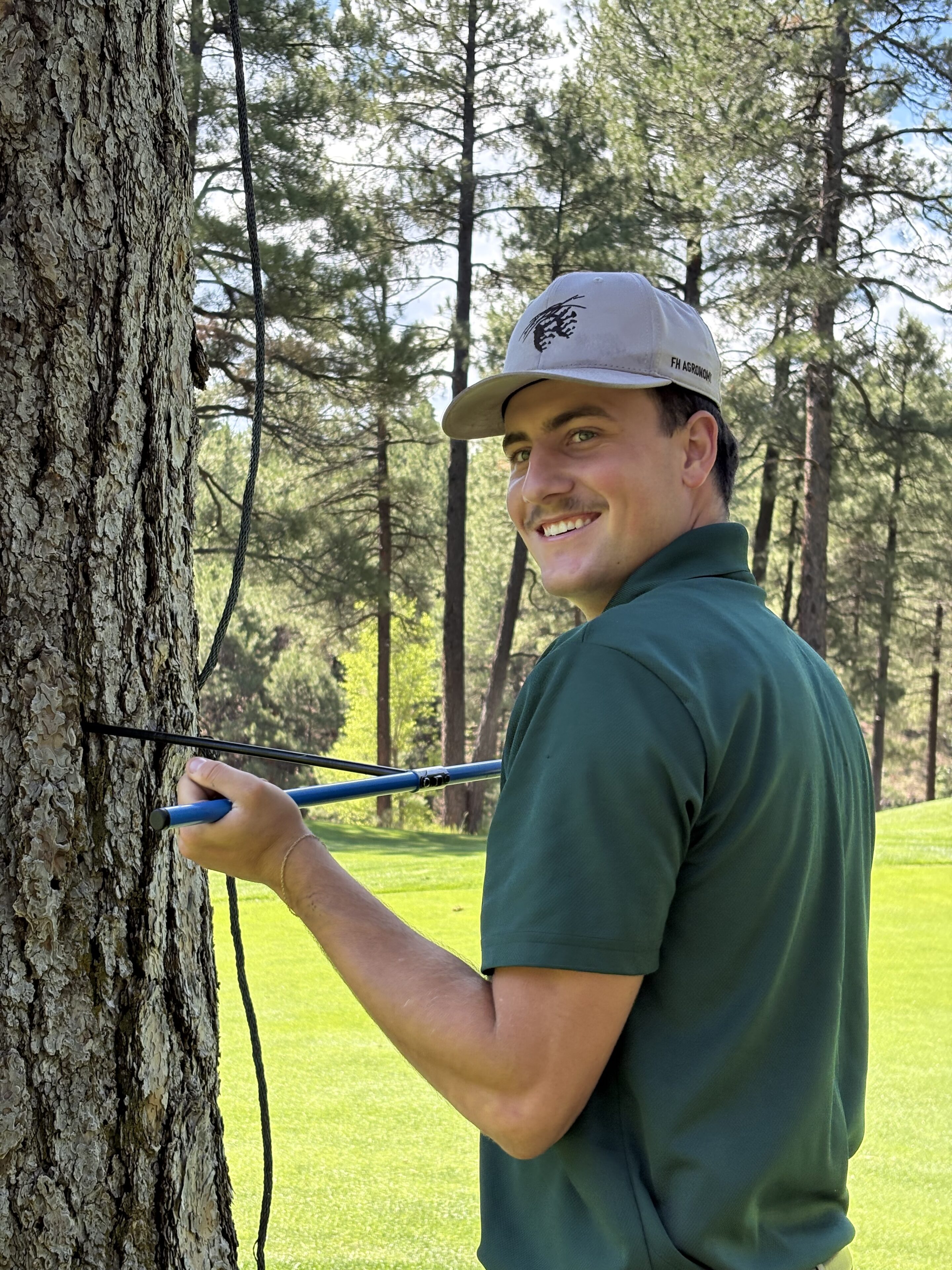
“Ralph’s curiosity, initiative, and interest in applying forestry research to a real-world management challenge made him a strong fit for this fellowship,” says Bryant.
“It was a really awesome opportunity,” says Testa. “I don’t know how I could’ve passed it up.”
Into the trees
Over 10 weeks, Testa compared ponderosa pines growing under three different conditions at FHGC: trees surrounded by irrigated turf, trees growing among native grasses with some irrigation exposure, and control trees outside the golf course’s irrigation.
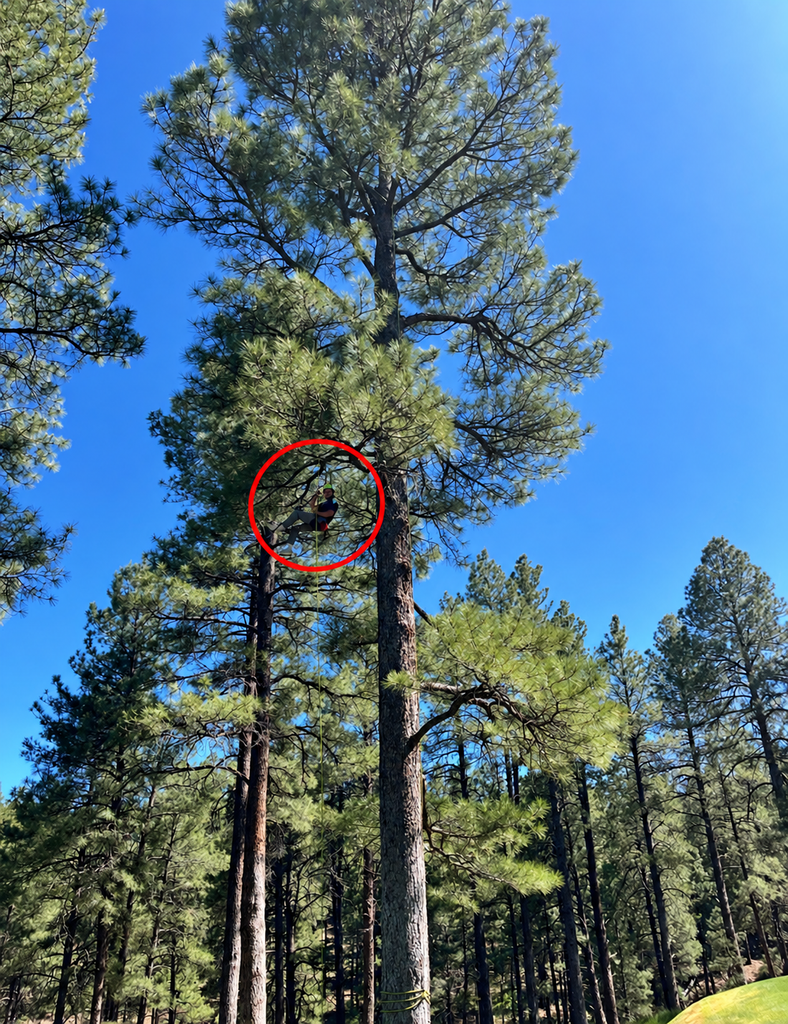
Using a slingshot and throw line, Testa climbed into the canopy to collect branches and needles that could be used to measure indicators including photosynthesis and water stress. He also collected soil cores to examine root density at different depths.
His previous golf course experience proved useful in ways that went beyond the research itself. Much of the work took place while golfers were actively using the courses. Testa understood the rhythms and etiquette of a working golf course—where golfers were coming from, when to move aside, and how to explain his work without disrupting play.
“That was a big selling point for Ralph to be our guy,” Sutter says.
The partnership also gave Testa something difficult to replicate in a classroom: responsibility for managing a research project with a real stakeholder waiting to use the results.
Research with an immediate use
The summer’s results confirmed that the ponderosas surrounded by turf were experiencing greater stress. Soil cores also showed fewer fine and coarse roots in those trees than in the other groups Testa studied, limiting their ability to take up water and nutrients. Testa also found an unexpected difference between the club’s two courses: trees on the Canyon Course, which uses reclaimed water, showed greater root density than those on the Meadow Course, which uses well water.
“Our main takeaway is that the turf trees are becoming more stressed and there needs to be something done if they want them to live,” Testa says.
For Abbey, who has watched some of the trees grow over decades, the research also put numbers behind something he had long suspected.
“We knew that excessive water was detrimental, but we were anxious to have data collected to understand just how badly these trees were reacting from the irrigation,” Abbey says.
Now, Abbey says, the research is beginning to shape what happens on the ground.
FHGC is experimenting with applying biochar around selected trees and exploring potential irrigation renovations around signature ponderosas. Testa plans to continue studying biochar through a greenhouse experiment, with the goal of determining whether it could help improve soil conditions and extend the lives of the trees.
“The goal is to increase the time span that these trees survive on these golf holes and see if we can make them healthier as well,” Abbey says. “We want to be stewards, and be promoting their health, not diminishing it.”
A living laboratory close to campus
The project has already opened the door to further collaboration between FHGC and the School of Forestry.
“Through our partnership with Forest Highlands, School of Forestry students and faculty are applying their expertise to real-world forest management needs, creating meaningful hands-on learning experiences while supporting the health and resilience of the forests,” says School of Forestry Executive Director David Auty.
FHGC offers NAU students an unusual field laboratory only minutes from campus: nearly 1,200 acres where questions of forest health, wildfire mitigation, water, land management, and recreation converge. Club leaders hope future students and faculty will use the property for additional research and field experiences, while FHGC gains expertise that can inform how it manages its courses.
Testa plans to continue his education in forestry after completing his undergraduate degree in May 2027, either through NAU’s accelerated master’s program or by pursuing a PhD.
“I would love to work with Ralph for the next couple of years. I’m looking forward to continuing the partnership,” says Abbey.
Support the next Dean’s Distinguished Fellow.
Your gift to the Dean’s Distinguished Fellowship gives CEFNS students the opportunity to conduct original research alongside faculty mentors, building skills, experience, and relationships that prepare them for careers in STEM.


