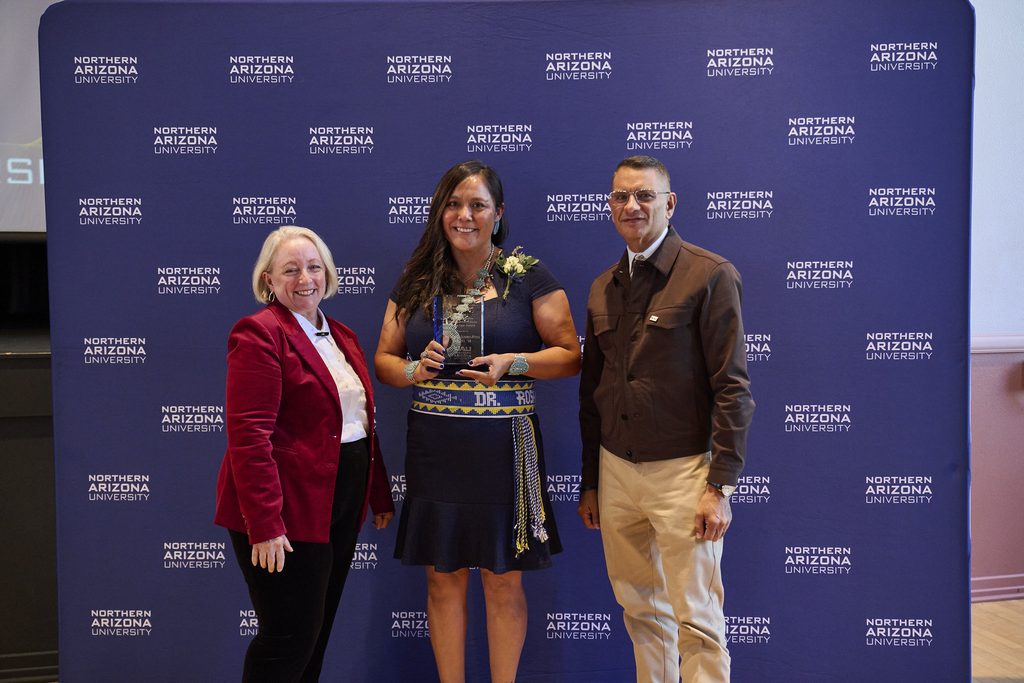
Rosanna Jumbo-Fitch, ’09, ’11, ’18, grew up in Chinle, Arizona, surrounded by construction.
Her father worked in civil construction, building roads, grading land, and operating heavy machinery, and Jumbo-Fitch sometimes joined him on projects. With a childhood spent around construction sites and male cousins, she was comfortable in a world largely occupied by men.
But when she arrived at Northern Arizona University in 2004 and walked into her first construction management class, her confidence wavered. Of the students filling the large lecture hall, only two others were women.
“I was like, ‘What am I doing in here?’” she recalls.
Fortunately, she found encouragement from a professor who reminded her “You’re here for a purpose. You got into the same program as them and you’re able to complete the same coursework. Don’t be afraid.”
More than two decades later, Jumbo-Fitch has managed more than $250 million in school construction projects, established her own construction company, earned three NAU degrees, taught at her alma mater, and served as an elected leader of her hometown, overseeing more than $50 million in community investments.
In recognition of her contributions to education, infrastructure, and civic life, she is the recipient of NAU’s 2026 Dr. Cliff Harkins Distinguished Citizen of the Year Award, which recognizes graduates for outstanding service through government, education, nonprofit work, and other contributions to society.
Finding her place
During her undergraduate at NAU, Jumbo-Fitch found belonging in places beyond her major. Building on her high school JROTC experience, she joined NAU’s Army ROTC program. She participated in the Women in Construction club, the Native American Business Organization, and Native student mentorship activities, including outreach to students at Flagstaff High School.
Each new experience strengthened her confidence and expanded her sense of what she could accomplish.
“If I can graduate, I can do it again,” she recalls thinking.
And she did. Encouraged by a professor, she pursued a master’s degree in project management, completing the coursework online while balancing her career and personal life. She later enrolled in NAU’s doctoral program in curriculum and instruction.
According to Jumbo-Fitch, each degree built on the last. Construction taught her how to execute complex projects. Project management strengthened her ability to plan and lead them. Education gave her the tools to pass that knowledge on.
Her dissertation brought those interests together, exploring how Diné culture and language could be integrated into construction management education.
At the time, she found little published research connecting Navajo history and construction management. Drawing on her professional experience and Diné cultural knowledge, she worked to demonstrate how Indigenous perspectives could enrich the field.
“Traditionally when we are building or reconstructing something, you’re supposed to treat it in a beautiful, harmonious fashion,” she explains. “Everything you touch or disturb has to be gentle, has to be calm.”
That emphasis on respect, balance, and responsibility informed her approach to projects throughout northern Arizona, from residential construction and commercial renovations to school facilities for Flagstaff Unified School District. For Jumbo-Fitch, the success of a project is measured not only by its completion, but also by how well it serves the people who will live, work, or learn within it.
She later brought that perspective back to NAU as a faculty member, teaching construction management labs and helping students apply classroom concepts to real-world projects. Some of her former students eventually joined her on construction sites.
Returning to the classroom also gave her a chance to witness how much the field had changed since 2004. This time, she looked out at more women pursuing the same profession in which she had once felt so conspicuous.
A call home
For all that Jumbo-Fitch accomplished away from Chinle, her hometown remained central to her sense of purpose.
Her childhood hadn’t been easy. Her family experienced poverty, domestic violence, and profound loss. They moved frequently and, at times, lived without running water. She watched her parents struggle to provide for their children, even as they encouraged them to pursue opportunities beyond the reservation.
Her grandmother taught her that the reservation would always be there. Her responsibility was to go out into the world, gain an education and useful skills, and eventually bring that knowledge home to help her people.
When COVID-19 struck the Navajo Nation, that responsibility became immediate.
Communities went into lockdown, and families struggled to obtain basic necessities. After an uncle reached out for help, Jumbo-Fitch and her husband began delivering food, water, diapers, and other essential supplies.
The emergency exposed Jumbo-Fitch to longstanding needs in Chinle that extended far beyond the pandemic. She had spent years managing complex construction projects, and she began to see how that expertise might serve her community on a much larger scale.
Despite having no political experience, she ran for Chinle Chapter president and was elected in 2021.
Once in office, she discovered a list of proposed community projects that had been sitting on a wall for years. Some, she recalls, dated back to 1954.
Drawing on her construction and project management experience, Jumbo-Fitch got to work. She and her team reviewed stalled projects, identified obstacles, established priorities, and pursued funding through the Navajo Nation, federal programs, and grants. They developed budgets, schedules, and proposals for buildings, infrastructure, and essential services that could benefit Chinle for generations.
One long-awaited improvement was the $8.1 million rehabilitation of the Chinle Airport runway, completed in 2024 after a yearslong effort to secure funding.
The runway, previously riddled with potholes and cracks, serves an estimated 1,200 flights annually, many of them medical emergencies. In a region where access to hospitals and specialized care can be difficult, a safer runway means more reliable emergency transportation for patients who need treatment elsewhere.
Jumbo-Fitch remembers the medical professionals who came to see the completed work: doctors, nurses, EMTs, and helicopter pilots.
“They all came out and said, you do not know what this means,” she recalls, “because now we’re able to not only transport our medical patients from hospital to hospital, we’re able to actually provide that service safely.”
Raising the bar
Jumbo-Fitch’s four years as Chinle Chapter president ended in 2025, but her commitment to the community continues.
Today, she mentors young students, encourages Native youth to pursue higher education, and works to help children maintain connections to their Diné language, culture, and history.
She often talks with young people about their clans and the responsibilities they carry to their families and communities. For Jumbo-Fitch, her own four clans represent qualities she strives to embody, including creativity, resourcefulness, exploration, connection to place, and courage.
“It’s written in my clanship that I’m going to do my best to ensure that my next generation is going to raise the bar,” she says.
It’s a responsibility she traces back to her parents, grandparents, and the mentors who helped her recognize her own potential.
“I just feel like I always have to give back because if my elders did so much to get me to where I am, I should pay them back in return,” she says.
Chinle will always be her first home. But after three degrees, years of mentorship, and a career shaped by the opportunities she found there, NAU has become another: “I tell everybody NAU is my second home.”