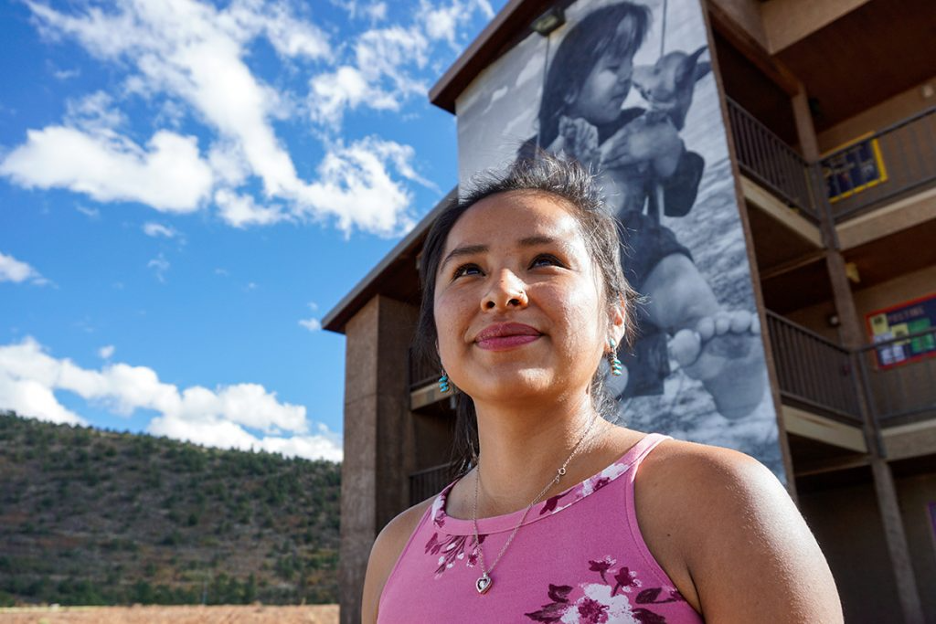
Growing up on the Ramah Navajo Reservation in New Mexico, Shawna Woody, ’26, gained an understanding of nature’s interconnectedness through her grandmother’s teachings.
In the spring, they would watch as pollinators like bees and butterflies returned to the blooming wildflowers. Summer brought the cicadas, their electric trills filling the air. And as autumn turned to winter, the insects would burrow underground, preparing for the cold. Each small creature, her grandmother explained, plays a role in the balance of the landscape.
Now, as Northern Arizona University’s (NAU) first Thomas D. Sisk Fellow, Woody carries that wisdom into her work as a conservation scientist.
The Thomas D. Sisk Fellowship supports NAU graduate students pursuing applied conservation science and prioritizes bringing underrepresented voices into the field. The Fellowship was created through a $250,000 fundraising effort, the fellowship honors the legacy of Thomas Sisk, a conservation biologist and the first professor of the Olajos-Goslow Chair at NAU.
Woody, a master’s student in Environmental Sciences & Policy, began the two-year fellowship in fall 2024 under the guidance of her primary advisor, Clare Aslan, chair of NAU’s School of Earth and Sustainability. Her research examines the impacts of bison on plants and pollinators on the North Rim of the Grand Canyon, an area of both ecological and cultural significance.

The North Rim, part of Grand Canyon National Park, sits within the larger Kaibab Plateau, a unique, high-elevation ecosystem in northern Arizona. It is one of only a few places in the U.S. with free-ranging bison. Originally introduced in the early 1900s as part of a failed cattle-breeding experiment wherein roughly 100 escaped, bison now roam the area, impacting its plants and pollinators in ways that remain largely unknown. Woody’s work aims to better understand these interactions, providing critical insights for conservation policies.
“For many tribes, bison are sacred, and so are many of the plants and insects they interact with,” Woody explains. “My work allows me to honor those cultural traditions while contributing to science.”
By studying how bison grazing affects plants like the Kaibab penstemon (Penstemon pseudoputus) and the bees and butterflies that rely on them, Woody aims to inform better management strategies, especially as climate change complicates these interactions.

“When it comes to conservation, there is often a disconnect between universities and broader society,” says School of Earth and Sustainability Professor Duan Biggs, NAU’s current Olajos-Goslow chair and one of Woody’s advisors.
Academic research provides valuable insights into conservation, but turning findings into solutions requires collaboration with implementation agencies—organizations that apply conservation strategies in the field. A cornerstone of the Sisk Fellowship is partnering fellows with these agencies to build confidence, foster career connections, and ensure their work will have real-world impact.
Woody has teamed up with the Grand Canyon National Park and Kaibab National Forest, focusing on creating sustainable land management strategies that protect wildlife and maintain healthy ecosystems.
“The fellowship and the support I’ve received are opening new doors for me. It makes me feel like I can succeed in graduate school and beyond,” says Woody.
Woody’s educational path was untraditional, including significant breaks between schooling to support her family and explore her passions. After earning an associate degree in rangeland management at Southwestern Indian Polytechnic Institute and a bachelor’s degree in biology at Fort Lewis College, she joined NAU’s Research Assistant Mentoring Program (RaMP), which helped her prepare for graduate studies.
Looking ahead, Woody hopes to return to her hometown of Ramah and establish a nonprofit that bridges conservation and cultural education, a goal that feels increasingly within reach thanks to the knowledge and experience she is gaining through the Sisk Fellowship.
“Shawna is wonderful,” says Biggs. “She is bringing novel perspectives to an important conservation issue. She’s eager to learn and committed to giving back to her people and the southwest.”
The Sisk Fellowship represents a bold vision for conservation: one that integrates academic rigor, cultural heritage, and practical action to address the Southwest’s most pressing environmental challenges. With fellows like Shawna Woody leading the way, its impact is only just beginning.